Among the ancient peoples of South America, the Inca are perhaps the best known: their vast empire and its magnificent buildings are awe-inspiring. But they were not the only ones.
In Ecuador, the Yumbo are believed to have preceded the Inca, who overtook them. The Yumbo nearly disappeared during the Spanish colonial period and were not really known to Ecuadorians until ethnohistoric research by Frank Salomon about them was published in 1997. The areas the Yumbo inhabited were not really explored until recently, and their ancient homeland is still mostly uninhabited.
It is on this traditional land of the ancient Yumbo, in the cloud forests of the Andes, that TiME’s partner Nuestra Tierra Aldea Creativa (NTAC) has established their center and aim to conserve a portion of the forest. Paulina Oviedo is NTAC’s founder and CEO. Studying psychology at Universidad Politécnica Salesiana, she conducted a field study living among the Shuar Indigenous people and wrote a thesis on their comsovisión, or worldview. We speak with the help of Sandra ten Zijthoff, a member of NTAC’s team and Paulina’s partner; Paulina speaks little English, and I speak no Spanish.
Because of the time she spent with the Shuar people, Paulina formed and fostered connections with various Indigenous Ecuadorian groups and has worked with them to change the reality of the people and the forest. NTAC was born to steward and protect the land, as well as to function as a hub for the empowerment of environmental leaders. Paulina invites Indigenous and Mestizo leaders from all across Ecuador, many of them women, to spend time together in the forest. Many of the women come from male-dominated cultures, and the time they spend at NTAC is an opportunity to explore their own path: still within their culture and traditions, but in a different and freer environment. By offering a safe hub away from their communities, NTAC provides a space where representatives are able to connect with one another, work together for the environmental protection of their homes, and develop leadership skills and tools for improving their lives.
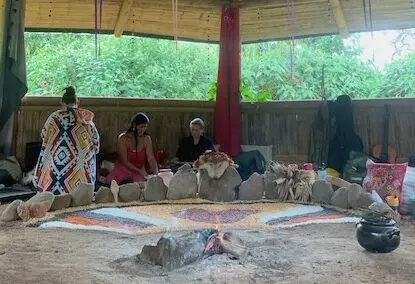
Near NTAC’s center is the portion of forest known to locals as Río Roberto — other than the Yumbo’s empty culuncos, or trails, it is completely uninhabited and untouched. And yet, can we call a forest truly pristine when ancient paths criss-cross through it? We know that prehistoric groups shaped the forests and lands they lived in, influencing the type of vegetation and the soil still present to this day. And the Yumbo are hardly prehistoric: the combination of Inca cultural occupation, a volcanic eruption, and European diseases spread by Spanish colonization led them to migrate from the area during the 17th century. The Tsáchila people believe themselves to be the Yumbo’s descendants, a claim that has been accepted by many researchers who believe that the remaining Yumbo integrated with other groups and adopted the Quechua language dominant in the Inca empire. Currently, they live mainly in the western foothills of the Andes, in the Pichincha province.
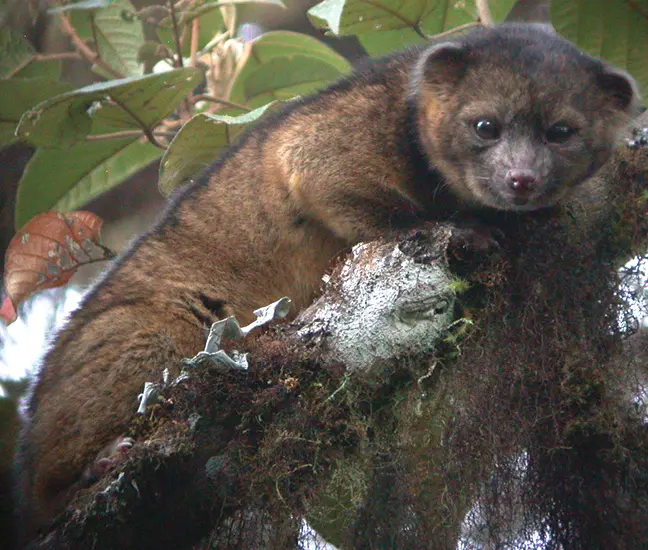
Río Roberto is almost uncharted — maps do not grant it a name. As it is very hard to access, it is also understudied. Paulina and Sandra are positive that new species of both animals and plant life can be found if the land is studied — just like the Olinguito (Bassaricyon neblina), which was “discovered” in the region just thirteen years ago.
People did, of course, know the Olinguito, even if science did not. Locals encountered them, and specimens have been present in museums and zoos around the world for the past century. Yet, the animal had been misidentified as an Olingo (genus Bassaricyon). While studying the museum samples and historical field data, researchers found that some of the Olingos were in fact not Olingos: they were smaller, had a different skull, and were found in much higher altitudes in the Northern Andes than Olingos typically live. Upon this discovery, they led an expedition and managed to locate the Olinguito in the Andean cloud forests, which “are a world unto themselves, filled with many species found nowhere else,” according to Kristofer Helgen, the leader of the research team.
Paulina and Sandra describe Río Roberto as teeming with life, with indescribable biodiversity: they try to explain just how many forms of life they encounter in their day-to-day life, but struggle to find the words. “You sense the life around,” they tell me. “The noises, the scents — it encompasses you.” Since the cloud forest stretches across different levels of elevation, species vary wherever you go. Comparing the forests near NTAC to the Amazon, where Sandra previously spent time, she says that “everything in the Amazon feels big: from the insects to the trees. But here, in the Andes, there is a mystical quality to the air. The peak of a volcano is seen, and glacial and Pacific air sweeps in.”
The current owner of Río Roberto is 96, and he is selling the land for a very good price. Once he passes away, his children will inherit the land, and Paulina and Sandra worry that they may not wish to sell it. This is one of the last local areas that has not been deforested, and conserving it will protect forever the Critically Endangered Ecuadorian White-fronted Capuchin, a little-known primate that survives in several localities in Ecuador and the northern edge of Peru. (In fact, they are so understudied that researchers are not fully certain about their taxonomic classification.) Other species that inhabit the forest include the Endangered Black-and-chestnut Eagle, two amusingly-named frogs — the Endangered Darwin Wallace Poison Frog and Vulnerable Pinocchio Rain Frog — and the Near Threatened Olinguito.
Living near the forest can be dangerous. When Paulina’s daughter was eight years old, she encountered a Vulnerable Spectacled Bear: not even deep in the forest, but among the houses. Having been wise enough to stand still until the bear departed, she left unscathed, though pale with fright. The Spectacled Bear is shy and timid compared to a Grizzly Bear, and usually remains in the forest. Still, when the structures of NTAC were still only half-built, someone managed to open the cooler and toss around bags of lentils and rice; Sandra strongly suspects the criminal to have been a bear.
Pumas roam — tracks can often be spotted — and midges bite incessantly; but the most dangerous creature lurking around is the deadly viper. Still, Sandra says the only thing she feels for the forest is love. By spending time fasting in the forest, she can feel different vibrations and can deeply connect to the trees and the life around her.
The combination of spiritual healing and conservation can raise eyebrows, but Sandra and Paulina consider them complementary. The disconnect between people and nature, they say, is the cause as well as the symptom of environmental destruction: healing this connection can heal ecology. This is the same principle that guides TiME’s educational program: we want to save that which we love and relate to.
NTAC has become a hub for both scientists and Indigenous leaders, both working on the same problem from different angles: caring for the forest, detecting wildlife, and fostering a stronger connection between science and Indigenous knowledge. While the research teams identify amphibians, track environmental DNA, monitor species through camera traps (unless Spectacled Bears remove them, as they did last December: see video above), they also talk to Indigenous leadership groups. Indigenous leaders possess knowledge about the forest that is often not otherwise available to researchers: they know which plants are edible, where to plant banana trees, and how to detect which animals have passed through the forest. They also perform rituals at the waterfalls and sing to them, asking for permission to enter the forest. This is a practice that, perhaps, we could all benefit from: treating the forest as a neighbor or a friend, rather than a highway to be used freely. Indigenous leaders often say they can hear the screams of pain echoing from trees as they are being removed, and Paulina found one of her friends sobbing when she saw trees being toppled near her house. The friend felt as though pieces of her were being torn off together with the trees. One day, she says, we will fully realize the consequences of these actions.
The cloud forest on the eastern slope of the Andes is severely deforested and fragmented. The connections between the preserved parcels of forest like Río Roberto are precious, few, and crucial to the survival of species that depend on the habitat’s highly specific conditions of altitude and humidity and therefore cannot adapt or relocate. The lack of a community living in the area means that there are no intervening politics or people to negotiate with: once the forest is preserved, it will survive for its own sake, though preserving the river would also ensure a continued water supply to the villages located downstream.
Nuestra Tierra Aldea Creativa will ensure that Río Roberto remains one of the last safe havens of pristine cloud forest for the benefit of the teeming life that inhabits it, for current and future ecological and Indigenous leaders, for scientific researchers, and for the ghosts of the Yumbo.
We thank Sandra ten Zijthoff and Paulina Oviedo for their help in preparing this article.
References
Boubli, J.P. et al. “Cebus Phylogenetic Relationships: A Preliminary Reassessment of the Diversity of the Untufted Capuchin Monkeys.” American Journal of Primatology 74: 4 (2012), 381-393.
Di Corcia T, et al. “Uniparental Lineages from the Oldest Indigenous Population of Ecuador: The Tsachilas.” Genes (Basel) 12:8 (2021), 1273.
Editorial. “Smithsonian scientists discover new carnivore: the olinguito.” Smithsonian. Published August 15, 2013. https://www.si.edu/stories/olinguito-discovery
Jack, Katharine M. and Fernando A. Campos. “Distribution, Abundance, and Spatial Ecology of the Critically Endangered Ecuadorian Capuchin (Cebus Albifrons Aequatorialis).” Tropical Conservation Science 5:2 (2012), 173-191.
Levis, C. et al. “Persistent effects of pre-Columbian plant domestication on Amazonian forest composition.” Science 355 (2017), 925-931.
Lippi, Ronald D. et al. “Return of the Yumbos: A cultural happening in Nanegal, Ecuador.” Native peoples, archaeologists, sacred sites and human remains in Latin America: Some case studies in collaboration: 79th Annual Meeting of the Society for American Archaeology (2014).
Lippi, Ronald D. “Yumbo Demographics Before and After 1532.” 29th Midwest Conference of Andean and Amazonian Archaeology and Ethnohistory (2001).
Maezumi, S Yoshi et al. “The legacy of 4,500 years of polyculture agroforestry in the eastern Amazon.” Nature Plants 4:8 (2018), 540-547.