“[It] seems probable to me that a wide extent of unbroken and equally lofty virgin forest is necessary to the comfortable existence of these animals.”
—Alfred Russel Wallace (1869), writing of orangutans in The Malay Archipelago (The Land of the Orang-Utan and the Bird of Paradise, A Narrative of Travel, With Studies of Man and Nature)Person of the Forest
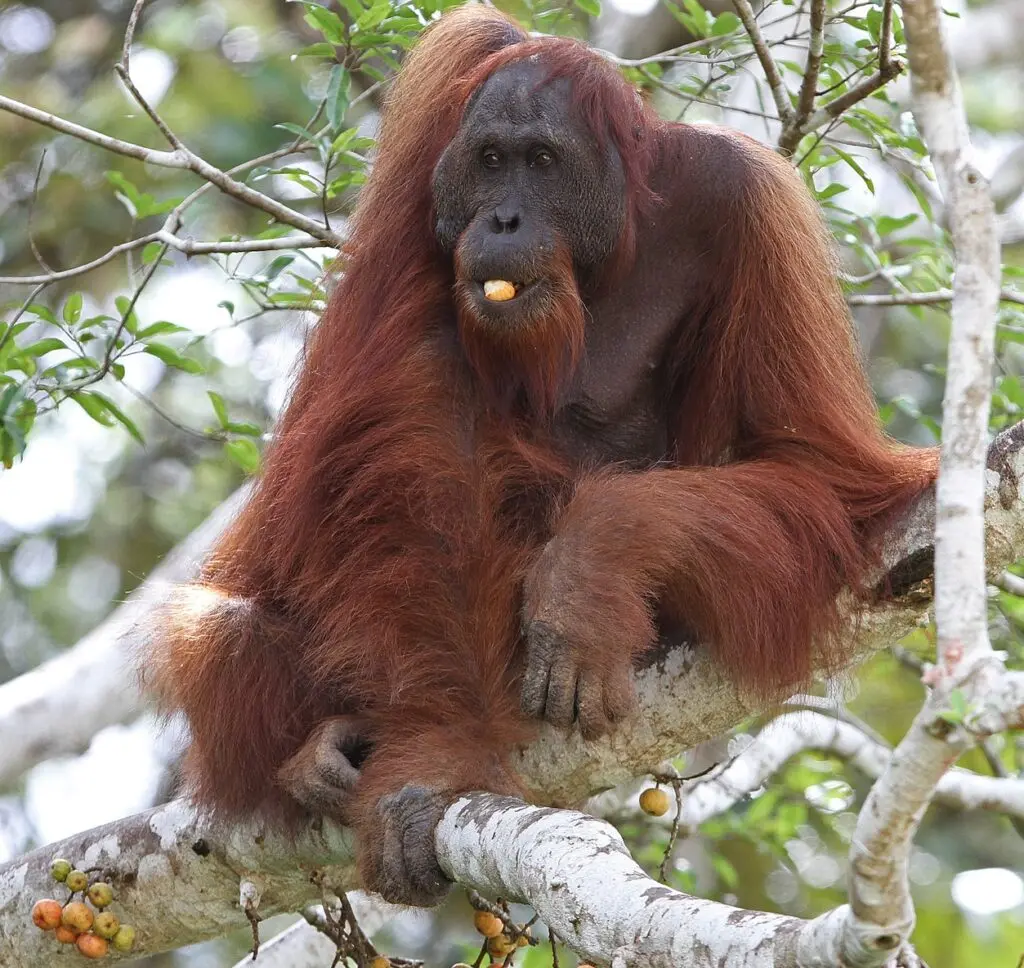
When the self-taught British naturalist Alfred Wallace traveled in the mid-1800s to the Malay Archipelago, as it was then known (a region that today includes Borneo, Singapore, Indonesia and Papua New Guinea), he discovered a wide range of amazing wildlife amid the vast, pristine tropical rainforests. In Borneo he marveled at great apes living and traveling in the forest canopy. Local inhabitants called these animals orangutan — which in Malay literally translates to “person of the forest.”
Over 160 years after Wallace emerged from the jungles of Southeast Asia, the “wide extent of unbroken and equally lofty virgin forest” vital to the orangutan has been both reduced in total size and cut into pieces due to expanded palm plantations, timber operations and cattle ranching.
All of which raise an existential question: What happens to the “person of the forest” when their forest disappears?
August 19th marks World Orangutan Day. It highlights the various threats to survival faced by orangutans, particularly the devastation of habitat loss. Of course, the plight of orangutans is only one example of how deforestation around the globe constitutes a threat to the very existence of a multitude of species, in addition to deforestation’s severe consequences in terms of climate change.
Extinction
Uri Shanas, TiME’s founder, explains why land transformation currently counts as the primary cause of species extinction worldwide: “Every animal has its own natural range to support its existence. So when you shrink that land, it affects the number of animals. If you go below a certain [population] threshold the animal is at real risk of extinction.” Or as the saying goes, habitat loss may mean animals “go the way of the dodo.”
You remember the dodo, right? In the early 1500s the Portuguese landed on the then-uninhabited island of Mauritius, where they encountered a large-headed, grey flightless bird. Unthreatened to that point, the bird now known as the dodo showed no fear in the presence of humans. Hungry Portuguese sailors weren’t especially fond of the bird’s meat, but they relished the ease with which they could be slaughtered. The result? No one has seen a living dodo since 1662.
The Role of Islands
Unfortunately, in the years that have followed, the dodo was not the only island wildlife extirpated. As science journalist David Quammen wrote in his wonderful book The Song of the Dodo, Island Biogeography in an Age of Extinction, small islands are natural laboratories for the observation of species in isolated habitats under pressure. Quammen observed that over the past 364 years since the dodo was eradicated, the extinction of species has often been an island phenomenon. Among birds, for example, more than 90 percent of species and subspecies extinctions occurred on islands, in spite of the fact that only 20 percent of the world’s bird species are confined to islands. Three-quarters of those extinctions transpired on small islands.
Deforestation creates an effect on habitats not dissimilar to extinctions observed on small islands. The more land adjacent or near to a natural habitat that’s cleared for farming or logging, and the more roads and human structures that interrupt the natural range of an animal, the smaller and more isolated is the resulting habitat. And the smaller the space, the greater is the pressure placed on species’ populations via shrinking resources, as well as the greater risk of predation and human interference.
While some encouraging recent reports suggest the rate of deforestation may be decreasing slightly, according to the United Nations’ latest Global Forest Goals Report 2026, the decade between 2015 and 2025 saw the world lose more than 40 million hectares(150,000 square miles) of forest, mainly in South America and Africa. That’s an area slightly larger than Japan in just ten years!
A Recipe for Success
Fortunately, growing awareness of deforestation’s harm to wildlife, humans and the planet itself may be helping to slow it. But for those species located on shrinking “islands” at greatest risk, there is also a proven model for conservation. The purchase of land in biodiversity hotspots and, with the aid of local partners, the monitoring of the habitat can vastly reduce the chance that vulnerable species will go extinct.
“Biodiversity hotspots are a priority,” says Uri Shanas. “Each parcel of land is a story in conservation, serving as an example of [both] the threat and the solution.”
Uri explains that a very important component of TiME’s work is its partnership with local, typically Indigenous, land stewards. Indigenous peoples and local communities have proven the most effective guardians of the world’s most ecologically valuable forests. They currently manage over half — 54 percent — of the world’s intact forests, protecting their biodiversity.
TiME’s current campaign highlights three such hotspots, two in Ecuador and one in Brazil. For the price of a coffee, those who donate and vote have the opportunity to select from one of three quite different wildlife areas: The IKIAM Reserve is located in the Ecuadorian Amazon, a region particularly susceptible to deforestation for cattle ranching and timber. Also in Ecuador, but situated in the cloud forest, Río Roberto is now under threat from development. Meanwhile, Rocha Bros in Brazil acts as natural corridor between two other important ecological reserves.
No matter which land parcel TiME members elect to purchase, they will aid in the survival of endangered species in that habitat. Hopefully with greater activism and investment, none of these hotspots will turn into small islands and none of the wildlife there will “go the way of the dodo.”
By Avi Sirlin, author of The Evolutionist: The Strange Tale of Alfred Russel Wallace