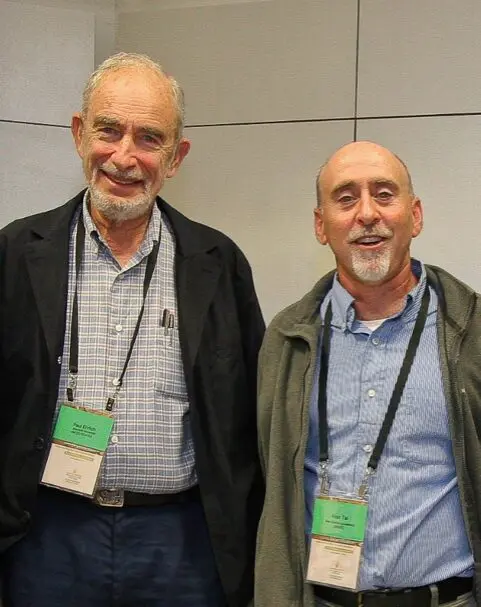
Paul Ehrlich was arguably the most influential ecological thinker of his generation. He was a towering human being and intellectual presence, driven by insatiable curiosity, a boundless reservoir of ideas, and an unwillingness to remain silent in the face of injustice, folly, or environmental destruction. For the past fifteen years, I have had the privilege of calling him a friend. For my wife and daughters, Paul and Anne Ehrlich quickly became part of our extended family during our visits to California.
Ehrlich was, first and foremost, a brilliant scientist. Over an extraordinary career at Stanford University, he authored hundreds of peer-reviewed articles and dozens of books — many co-written with Anne, his wife and partner for some 70 years — that together have been cited more than 100,000 times, a remarkable testament to his scholarly impact.
As a boy growing up in Philadelphia, he developed a fascination with butterflies and, by high school, had already become something of a prodigy in their study. He liked to say that had he gone into business, he might have been able to study butterflies for a few weeks each year on vacation; as an academic, he was fortunate to have spent his life getting paid to do so full time.
As his career evolved, Ehrlich expanded his scientific reach. Recognizing that birds attracted broader attention than butterflies, he became not only a leading lepidopterist but also a distinguished ornithologist. Yet the scope of his work defies disciplinary boundaries. His pioneering research on coevolution, his early documentation of biodiversity loss, and his studies of butterfly behavior and population dynamics helped establish modern field-based evolutionary ecology and secured his place among the most important biologists of the twentieth century. But he also researched and published in areas as diverse as social psychology and dentistry.
More than anyone I have known, Ehrlich thought globally. In 1968, still just a young biology professor, he wrote The Population Bomb, warning inter alia of dire consequences for global food security if population growth continued unchecked. But the book was far more than a prediction of famine. It explored the broader environmental implications of rapid population growth, including air pollution, water scarcity, and species extinction driven by habitat destruction — pressures that are all too evident today. In later years, he wrote extensively about climate change and ocean degradation, anticipating many of the defining environmental challenges of our time. His detractors labeled him a false prophet, a eugenicist, even a misogynist, but nothing could be further from the truth. Paul was as deeply committed to human rights and human well-being as anyone I have known.
It is true — and fortunate — that global hunger has not reached the catastrophic levels Ehrlich feared, thanks in large part to extraordinary advances in agricultural science. Ehrlich himself acknowledged this. Yet it is simply wrong to suggest that hunger has ceased to be a global crisis. The United Nations World Food Programme estimates that millions still die each year from hunger-related causes, while the World Health Organization reports that 149 million children under five are stunted and 45 million are wasted due to malnutrition. That these individuals may be invisible to critics writing from comfortable, air-conditioned offices does not make their suffering any less real. Paul saw them. It is also worth noting that those countries in sub-Saharan Africa that have reduced fertility and invested in sustainability, such as South Africa, Botswana, and Eswatini, do not face acute food-security crises.
Because he was outspoken, witty, and relentlessly informed, Ehrlich became a prominent public voice of the emerging environmental movement. He appeared so frequently on The Tonight Show with Johnny Carson that the actors’ guild once pressured him to join — as an academic celebrity, he seemed to be encroaching on the domain of Hollywood stars.
It was this public prominence that turned Ehrlich’s 1980 wager with economist Julian Simon over the future price of natural resources into a widely publicized event. Ehrlich lost the bet — writing Simon a check for $576 — when the prices of several metals declined over the agreed period. Yet even The Economist later observed that Ehrlich was, in effect, undone by timing: over the long run, the prices of scarce resources tend to rise as depletion advances. In retrospect, that short-term market outcome in no way invalidates Ehrlich’s broader insight about natural resources.
Most troubling is the persistent suggestion that Ehrlich’s warnings about carrying capacity somehow inspired coercive population policies. In reality, he consistently criticized human-rights abuses associated with such policies and advocated instead for voluntary approaches grounded in education and women’s empowerment. Throughout his career, he emphasized that empowering women and expanding access to family planning are the most effective and ethical paths to sustainability.
Paul lived an extraordinary life filled with adventure, much of it recounted in his 2023 autobiography, Life: A Journey through Science and Politics. Weekend walks with Paul were always illuminating, as he was a marvelous storyteller and a true raconteur. Even as he aged and his body weakened, his mind remained razor sharp. In his later years, as he faced a litany of health challenges, he often remarked, with characteristic candor, that “old age is not for sissies.”
Now that he is no longer with us, we are left with Ehrlich’s immense intellectual and moral legacy. As he reminded us time and again, denying the ecological consequences of a global population exceeding eight billion — or dismissing the concept of planetary carrying capacity — does not make those limits disappear. Nature is indifferent to ideology. Across the globe, ecosystems are signaling stress in ways that echo his warnings. Paul Ehrlich’s work was never a call for despair, but for foresight and responsibility. Ehrlich’s ideas, and the solutions he championed, continue to offer a path forward for humanity and for the only planet we will ever know.
Alon Tal is a professor of environmental policy at Tel Aviv University and an intermittent visiting scholar at Stanford University.