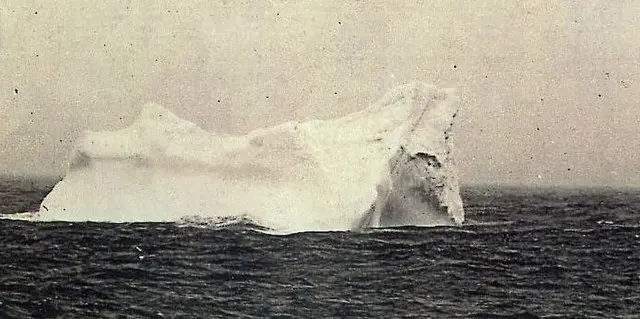
There is more than meets the eye, looks can be deceiving, and ninety percent of the iceberg is underwater.
This lesson was famously learned the hard way by RMS Titanic, which relied on the human eye to detect any obstacles in its way. On a moonless night, two lookouts were simply not enough to alert the crew in time and steer the giant ship away from the iceberg. Seen or not, the iceberg was there and took its toll.
For humans, sight is the most reliable sense for navigating the world. We say, “I’ll believe it when I see it,” suggesting that the only source we truly trust is our brain’s interpretation of light. We perceive the world via the auditory, olfactory, tactile and gustatory systems as well, but most of us treat them as supplementary sources of information.
The famed sinking of the Titanic inspired innovations in the field of marine navigation. The harsh lesson learned, in combination with the war needs of World War I, led to the creation of the sonar: a device that emits and receives auditory signals to detect underwater objects. While today’s sonars are not limited to underwater use, their primary function is to explore the depths. Light travels very short distances through H2O, and as anyone who has attempted to open their eyes underwater knows, the image received is distorted compared to what we see on land. Sound, on the other hand, travels long distances underwater, making sonar a highly reliable tool for sea navigation.
Alternative universes
For human convenience, sonar systems translate acoustic information into visual codes easy for us to decipher. But for many other organisms, sight is not necessarily the main source of input; for some species, auditory information is interpreted directly to learn about the environment. What justifies, then, the idea that the landscape — the way things are seen — should be the main focus of conservation?
“We comfort ourselves all too easily with the illusion that the relations of another kind of subject to the things of its environment play out in the same space and time as the relations that link us to the things of our human environment,” said the biologist Jakob von Uexküll. Von Uexküll coined the term umwelt (“environment” in German) to describe the environment as experienced by each species: the world as a multitude of worlds perceived by different animals. An umwelt is shaped by each species’ dominant sensory perception, the interaction of its body with its surroundings, and what is important for its survival. The tick’s perception of the world, says von Uexküll, is so different than ours — different enough to be considered a different environment, a different world.
The ninety percent
The term soundscape has gained popularity over recent decades to describe the acoustic counterpart of the landscape: the way sounds, and silence, combine to create a dimension of the perceived world. We know it, but we will never know it as well as some other species do; we visit its outskirts, treading along the margins.
And the extent of its importance to some species may occasionally come as a surprise. For example, when moths choose to lay eggs on plants, they carefully avoid the dehydrated ones. While we discern hydrated and dehydrated plants by their looks, it turns out that moths rely on subtle sounds emitted by dehydrated plants. When scientists played those sounds from the direction of a healthy plant and silenced the unhealthy one, the moth chose the wrong tomato plant to lay its eggs on.
What happens, then, when human-made noises constantly obscure these natural auditory signals?
Quite a lot — and reactions differ between species and occasionally even between individuals of the same species. As anyone who has ever resided near a highway know, noise can induce stress. The same is true for wildlife: the Greater sage grouse, a Near Threatened large bird that resides in the western regions of North America, exhibits measurable, physiological signs of increased stress when exposed to the sound of continuous gas drilling. Yet, we would be mistaken to think of the impact of noise only through the auditory understanding of humans.
The soundscape, much like the landscape, presents itself differently to every species based on their soundwave sensitivity and the information they gather from it; consider a sharp-eyed eagle impacted by nuances in the visual environment that humans are indifferent to. Similarly, given the various ways animals use sound to orient themselves in the world, different behavioral changes can occur in response to human-made noise.
For some species, anthropic noises mask their own sounds: birds that chirp at lower frequencies find it more difficult to communicate when the hum of traffic obscures their song. Some of them, like the Song sparrow, respond by changing their tune; others, like European robins, now avoid singing during the day when urban noise levels are higher. Noise pollution also masks some species’ ability to hear their prey, like the Greater mouse-eared bat, which is less successful in hunting when exposed to the din of traffic. Noise can also lead to distraction — in the presence of boat motors, Caribbean hermit crabs allowed predators to come closer than usual before hiding — and to hyper-vigilance, causing chaffinches to miss foraging opportunities.
Rocking the boat
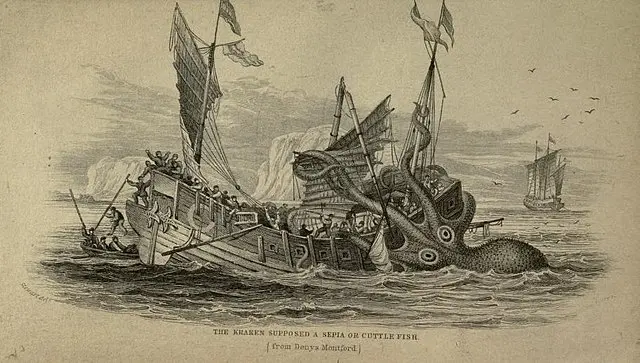
Giant squids are the hypothesized inspiration (amplified perhaps by fear, sun or rum) of the mythical Kraken, large enough to sink a ship with a blow of a single tentacle. Despite their size — up to 43 feet long, with eyes a foot in diameter — they are still very elusive, and the first video of a giant squid in its own habitat was taken only in 2012. In 2001 and 2003, nine giant squids —a symbol of the mysterious, unknown depths — were stranded on the coast of Spain. The reason was determined to be the use of seismic air guns nearby.
The environment most impacted by sound is the one strangest and least visible to us: the underwater world. In the depths, where darkness reigns and noise travels farther than through air, many animals have adapted to relying on sound as their principle sense. For the very same reason, human maritime craft use sound-based devices to navigate the oceans, with sonars emitting constant soundwaves.
While we can remain blissfully unaware of this enduring disturbance, for marine animals, their constant presence can prove deadly. In 2002, a mass stranding of beaked whales in the Canary Islands occurred within hours of the initial use of naval sonar in an international naval exercise. One explanation offered was that the sound caused the whales to panic and altered their dive pattern. The sensitivity of marine animals to noise is not restricted to sounds made underwater, either: a study found elevated levels of cortisol, the “stress hormone,” in the plasma of toadfish along the Miami coast during the 2019 Ultra Music Festival.
The song of the Sirens
Considering these different umwelts and the fact that many species operate in domains other than the visual means that sound can be used to track and trace the wellbeing of ecosystems. Bioacoustics, the study of animal sounds, is now monitored with and without AI tools to detect patterns and differentiate the sounds of different species. Variations in animal vocals mean that bioacoustic tracking can be used not only to detect population size, but also changes in behavior and possible stressors.
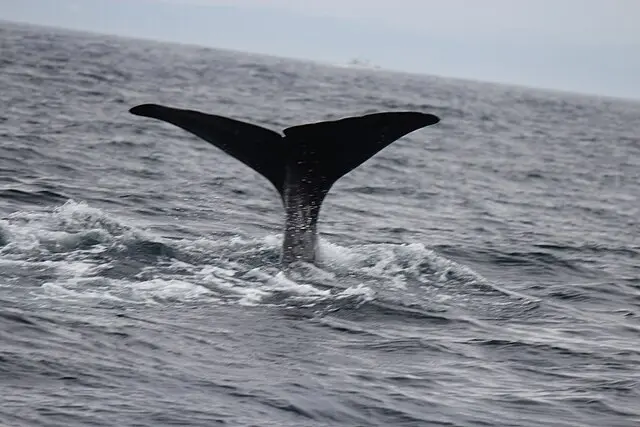
Taking advantage of the centrality of sound to different animals means that we can keep track of vulnerable animals that are hard to detect, like the massive Sperm whale, and measure cryptic behaviors that are hard to observe, like the rumbles the Critically Endangered African elephant use to communicate. We also may be able to reduce disturbances to habitats and the costs associated with monitoring hard-to-reach areas.
The world as we know it is merely one aspect, one face to an infinitely complex system, experienced by different organisms in completely distinct ways. The barrier between these worlds, however, is thin. This means that, on the one hand, we can try to experience a bit of the soundscape by closing our eyes and bathing in the noise, the chirp, the buzz and the whistle of the wind. On the TiME website, you will now find sound clips of the habitats we want to protect; you can not only see them through photos, but also hear them through a recording — a parallel and not less significant side of their existence.
On the other hand, we must actively remember that while hidden, the submerged part of the iceberg, is just as real, and just as impacted by our actions. As tragically discovered by RMS Titanic, neglecting to consider the invisible can have grave implications.
Author: Noga Syon
Editor: Liat Radcliffe-Ross
Cartolano, Maria C. et al. “Impacts of a local music festival on fish stress hormone levels and the adjacent underwater soundscape.” Environmental Pollution. 265 A (October 2020):
Chan, Alvin Aaden Yim-Hol et al. “Anthropogenic noise affects risk assessment and attention: the distracted prey hypothesis.” Biology Letters 6:4 (February 2010).
Clinton, Francis D. and Jesse R. Barber. “A framework for understanding noise impacts on wildlife: an urgent conservation priority.” Frontiers in Ecology and the Environment 11:6 (August 2013): 305-313.
D’Amico, Angela and Richard Pittenger. “A Brief History of Active Sonar.” Aquatic Mammals 35:4 (2009): 426-434.
Editorial. “What is sonar?” National Oceanic and Atmospheric Administration. https://oceanservice.noaa.gov/facts/sonar.html
Editorial. “R.M.S Titanic – History and Significance.” National Oceanic and Atmospheric Administration. Last updated July 18, 2024. https://www.noaa.gov/office-of-general-counsel/gc-international-section/rms-titanic-history-and-significance.
Editorial. “How bioacoustics and AI can help study animal populations in the forest and beneath the waves.” phys.org. October 23, 2024. https://phys.org/news/2024-10-bioacoustics-ai-animal-populations-forest.html
Fernández A, et al. “’Gas and fat embolic syndrome’ involving a mass stranding of beaked whales (family Ziphiidae) exposed to anthropogenic sonar signals.” Veterinary Pathology 42:4 (July 2005): 446-57.
Guerra, Angel & González, Ángel. (2004). “Calamares gigantes varados: víctimas de exploraciones acústicas.” Investigacion y ciencia 334 (July 2004): 35-37.
Lovett, Richard A. “Titanic Sunk by “Supermoon” and Celestial Alignment?” National Geographic, 2012. https://www.nationalgeographic.com/science/article/120306-titanic-supermoon-moon-science-iceberg-sky-sink
Patricelli, Gail L. et al. “Avian Communication in Urban Noise: Causes and Consequences of Vocal Adjustment.” The Auk 123:3 (July 2006): 639–649.
Quinn, John L. et al. “Noise, Predation Risk Compensation and Vigilance in the Chaffinch Fringilla coelebs.” Journal of Avian Biology 37:6 (November 2006): 601-608.
Rasmussen, Jeppe H. et al. “Sound evidence for biodiversity monitoring.” Science 385:6705 (2024): 138-140.
Suckow, Mark A. et al. “Chapter 5 – Light and sound in seawater.” Seawater (Second Edition). Oxford: Butterworth-Heinemann, 1995.
Teixeira, Daniella et al. “Bioacoustic monitoring of animal vocal behavior for conservation.” Conservation Science and Practice 1:8 (June 2019).
Von Uexküll, Jakob. A Foray into the Worlds of Animals and Humans. Minneapolis: University of Minnesota Press 2010 [1934].