“Who are you?” said the Caterpillar. This was not an encouraging opening for a conversation. Alice replied, rather shyly, “I—I hardly know, sir, just at present—at least I know who I was when I got up this morning, but I think I must have been changed several times since then.” “What do you mean by that?” said the Caterpillar sternly. “Explain yourself!” “I can’t explain myself, I’m afraid, sir,” said Alice, “because I’m not myself, you see.” “I don’t see,” said the Caterpillar. “I’m afraid I can’t put it more clearly,” Alice replied very politely, “for I can’t understand it myself to begin with; and being so many different sizes in a day is very confusing.”
Lewis Caroll, Alice’s Adventures in Wonderland
This widely quoted excerpt has been interpreted from a range of perspectives, from philosophies of the self, mental health and psychology to feminism and gender. But one of the major inspirations for Alice’s frequent changes in size was scientific: Darwin’s writings, which shook humanity’s understanding of itself. What are we, if we are a result of change? Can we accidentally change back to apes? A primal fear was invoked: that as humans, we are not meant to be — we just are.
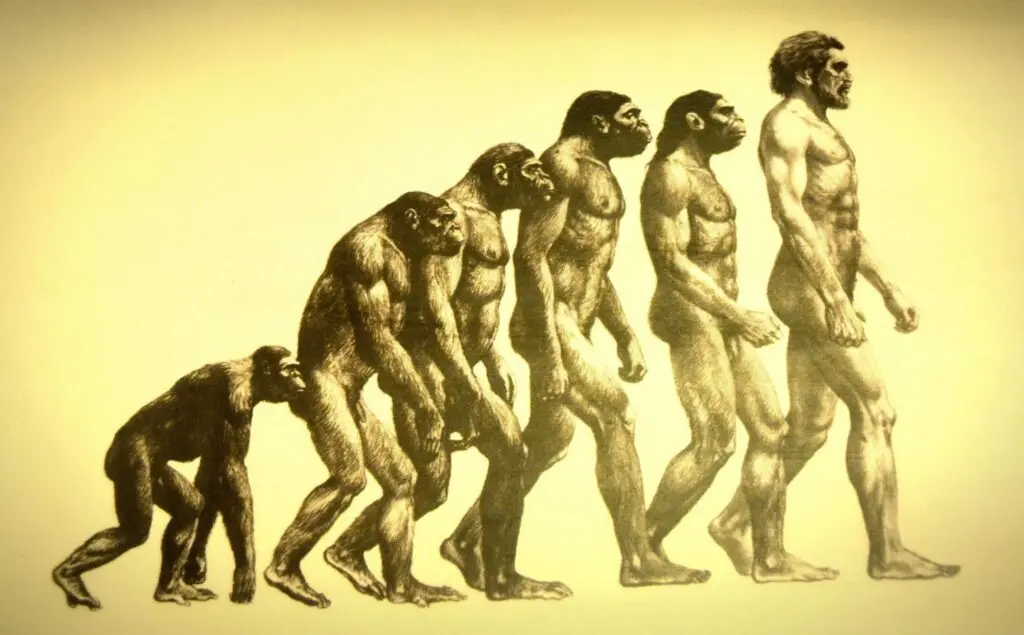
Even when evolution is accepted, we tend not to think of natural selection as a constant adaptation to the environment, but as a straight path leading to a destination: the species as we know it today. But the fears of Victorians like Lewis Caroll are not entirely misplaced, because natural selection is not a linear progression connecting one species to a more “evolved” and “advanced” version; Homo sapiens was never an ultimate goal. In his 1989 book, Wonderful Life, Stephen Jay Gould criticized the common understanding of evolution as a process of advancing from simple forms of life to better ones. The misconception is best represented by the iconography of “the march of progress,” showing an ape slowly turning into a fully developed, upright Homo sapiens.
But life is not linear: “life is a copiously branching bush, continually pruned by the grim reaper of extinction, not a ladder of predictable progress,” wrote Gould. And the truth is, Gould argued, that the fact we exist is anything but a necessity. He pointed to a collection of fossils in British Columbia, Canada, known as the Burgess Shale, a true wonder in that it preserves complete soft-bodied animals — a rare occurrence: most fossils found are only shells and bones. The Burgess Shale displays the Cambrian explosion, the rapid appearance of most organism families we know of today, around 542 million years ago.
The classification of many of the fossilized animals, to this day, is uncertain. Some argue that they belong to modern fauna families, while others, like Gould, classify them into completely different families. For this second camp, the fossils demonstrate that life could have taken a very different course. It is nothing but a happy accident (for us) that we have come to this day, whereas many of these animals are extinct.
What would happen if we restart “the tape of evolution”? Would it run the same course, resulting inevitably in the extinction of these animals, the rise of dinosaurs, mammals, and great apes? Would it run in a completely arbitrary manner? Neither, claimed Gould:
Any replay of the tape would lead evolution down a pathway radically different from the road actually taken. But the consequent differences in outcome do not imply that evolution is senseless, and without meaningful pattern; the divergent route of the replay would be just as interpretable, just as explainable after the fact, as the actual road. But the diversity of possible itineraries does demonstrate that eventual results cannot be predicted at the outset. Each step proceeds for cause, but no finale can be specified at the start, and none would ever occur a second time in the same way.
Had the fossilized Anomalocaris (an odd creature with three plates on its head) moved slightly to the right before its demise, perhaps it would have survived whatever killed it; a slight change in temperature and maybe the aptly named Hallucigenia (a “prickly worm”) would have dominated the Earth. Would mammals have developed, or survived, or grown to dominate the world in such a case? Would I be a Hallucigenia typing with my prickly legs and hypothesizing about a world comprised of soft, squishy mammals?
What a blow to our ego — what a disorienting thought. If we are not meant to be ourselves, I join Alice in asking, how can we explain ourselves?
Beetles or Horses?
The bias motivating us to think of evolution as linear also biases the way we think about conservation. “As we move from the furries and featheries, down through the innumerable species of insects, and on down to bacteria and viruses, sentimental concern does not merely wane. It changes sign,” wrote zoologist R. M. May in 1994. If these “less evolved” species are nothing but a stepping stone to the more evolved, why should they matter? One retort: often, it is thoseinnumerable species that display the most diversity of what life can be. Beetles, for instance, comprise 400,000 described species — meaning that many more potentially exist.
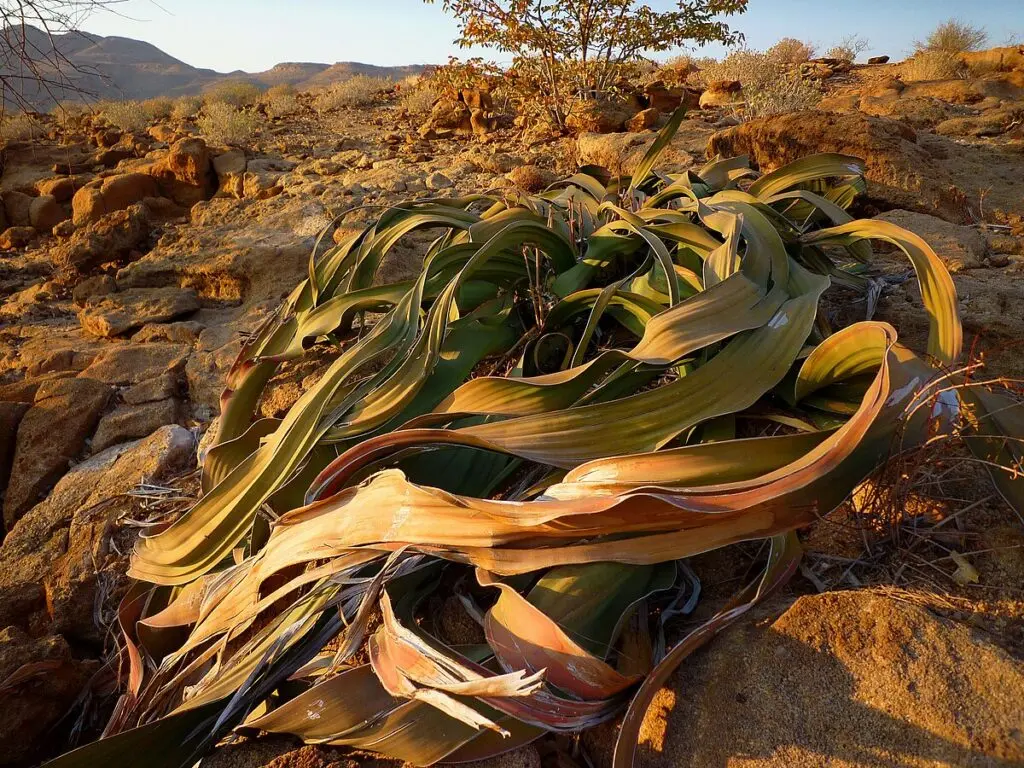
There are many different ways to think of biodiversity. We can place the highest value on species that diverged from their closest living relative hundreds of millions of years ago, like the Welwitschia mirabilis: an odd-looking plant considered a “living fossil” for being a relic from the Jurassic period. Or we can prioritize families of species according to the number of evolutionary twists and turns they underwent to reach their current form. The extinction of a species in such a set would not be the death of an entire branch of evolution, as would be the extinction of a living fossil. However, from the phylogenetic-diversity perspective, such families possess remarkable potential for adaptivity and an extensive array of features, and their survival can have a greater impact on whole ecosystems.
We are virtually compelled to the stunning mistake of citing unsuccessful lineages as classic “textbook cases” of “evolution.” We do this because we try to extract a single line of advance from the true topology of copious branching. In this misguided effort we are inevitably drawn to bushes so near the brink of total annihilation that they retain only one surviving twig. We then view this twig as the acme of upward achievement, rather than the probable last gasp of a richer ancestry. (Gould, 1989)
After discussing horses as a prime example of this fallacy, Gould added another blow to our ego: “Need I remind everyone that at least one other lineage of mammals, especially dear to our hearts for parochial reasons, shares with horses both the topology of a bush with one surviving twig, and the false iconography of a march to progress?”
Is it more reasonable, therefore, to prioritize the successful branches of evolution: the ones that survived, adapted, changed, and comprise unbelievable numbers? By focusing on distinct and unique species, we risk losing species that hold our world together.
Consider, for example, fungi (of all things). Very little is known about the majority of fungi; in fact, mycologists believe that most fungi species are what they consider “dark fungi”: much like a murderer detected by their fingerprint but absent from any database, we know they exist only due to remnants of DNA found in the environment. In fact, out of 2 million–3 million fungi species we know to exist, only around 155,000 have been formally named. Prioritizing “living fossils” would leave them out of conservation plans, especially because we know nothing about them. Yet, our world depends on fungi. Some fungi (of various families) form symbiotic associations with plants, making them crucial for the Earth’s forests and carbon storage. In fact, studies suggest that fungi may have may have facilitated early, rootless plants to obtain nutrients, develop, and and thus increase oxygen on Earth—which in part is responsible for the development of mammals and for your being a human rather than a plate-headed Anomalocaris.
It seems impossible to select, and yet, choose we must: our resources are limited. Biologist Marcel Cardillo argued that prioritizing species means prioritizing their existence, the inherent value of the fact that they are alive. I want to live in a world in which the Welwitschia mirabilis exists; if we do not protect it, a singular bit of life is gone, forever. Phylogenetic diversity, on the other hand, shifts the focus from conserving species to conserving features. It sounds cold and detached, and yet, can we truly ignore it?
Making a choice
Alice’s confusion is evident, then, and so are the Victorian fears that motivated it. We find it very difficult to rid ourselves of the sense that we are meant to be. But we are not. Our world, fortunately and unfortunately, is too complex: every instance of life is infinitely intertwined with the others. Every life is absolutely and tremendously contingent, arbitrary, and yet precious and indispensable. As Homo sapiens, we are the only living member of our genus: our extinction would be a tremendous loss, and at the same time, it would be infinitely less important than that of much more successful branches of evolution, those that formed extensive bushes and dominate the Earth to a greater extent than we ever could.
TiME’s mission to protect habitats is one way to face this complexity. In conservation, we have to embrace knowledge, including the knowledge that we will never know it all. Nature as is should be our number one priority, because only it knows itself, including the secret, hidden species and features they possess. As an individual or a species, perhaps we can never truly know ourselves, as Alice observed: our body is a relic in a long history we can never know, of natural selection in response to environments and threats that no longer exists. But the ecosystem does know itself, and we can conserve it by conserving the habitat.
Martin Buber famously spoke of a rabbi who used to say that each of us must always keep two truths close to our heart: “for my sake was the world created” and “I am but dust and ashes.” We are a unique occurrence of evolution: we are singular, indispensable, and possess the power to change the world for better and for worse. But on the other hand, we are an outnumbered, short-lived species on a planet vibrating with an immeasurable variety of life. May we appreciate the wonder that is us and remember that our wonder is no more wondrous than any other.
Author: Noga Syon
Editor: Liat Radcliffe-Ross
Published September 3, 2025
Antonelli, A., et al. State of the World’s Plants and Fungi 2023. Royal Botanic Gardens, Kew.
Cardillo, Marcel. “Phylogenetic Diversity in Conservation: A Brief History, Critical Overview, and Challenges to Progress.” Cambridge Prisms: Extinction 1 (2023): e11.
Gould, Stephen Jay. Wonderful Life: the Burgess Shale and the nature of history. New York: Norton, 1989.
Jürgens, Norbert and Imke Oncken et al. “Welwitschia: Phylogeography of a living fossil, diversified within a desert refuge.” Scientific Reports 11 (2021): 2385.
Lerer, Seth. Children’s Literature: A Reader’s History from Aesop to Harry Potter. Chicago: Chicago University Press, 2008.
May, Robert M. “Conceptual Aspects of the Quantification of the Extent of Biological Diversity.” Philosophical Transactions: Biological Sciences 345:1311 (July 1994), 13-20.
McCoy, Skip R. et al. “The complete plastid genome sequence of Welwitschia mirabilis: an unusually compact plastome with accelerated divergence rates.” BMC Evolutionary Biology 8 (2008): 130.
Mello, Antonietta and Raffaella Balestrini. “Recent Insights on Biological and Ecological Aspects of Ectomycorrhizal Fungi and Their Interactions.” Frontiers in Microbiology 9 (2018): 216.
Van Galen, Laura G. et al. “The biogeography and conservation of Earth’s ‘dark’ ectomycorrhizal fungi.” Current Biology 35:11 (2025): PR563-PR574.
It almost goes without saying that conservation and environmental education go hand in hand. TiME is leading actual change through hope We want to save endangered species and critical hotspots, and we...
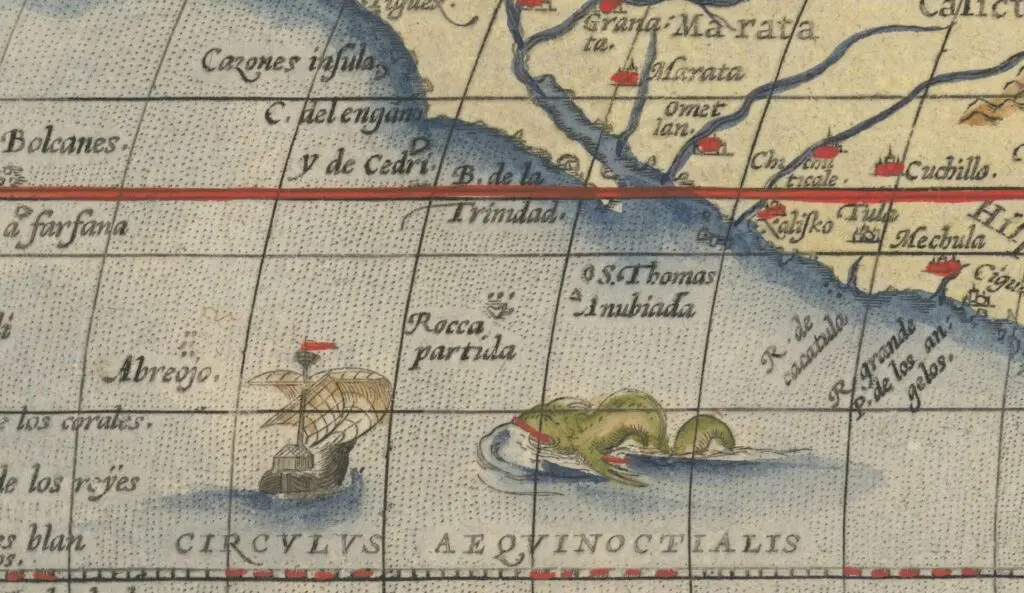
Dragons, sea serpents and blank spaces are hallmarks of medieval-European maps, representing geographic spaces that early cartographers knew were not yet known. In our modern age, it is commonly thought that there...