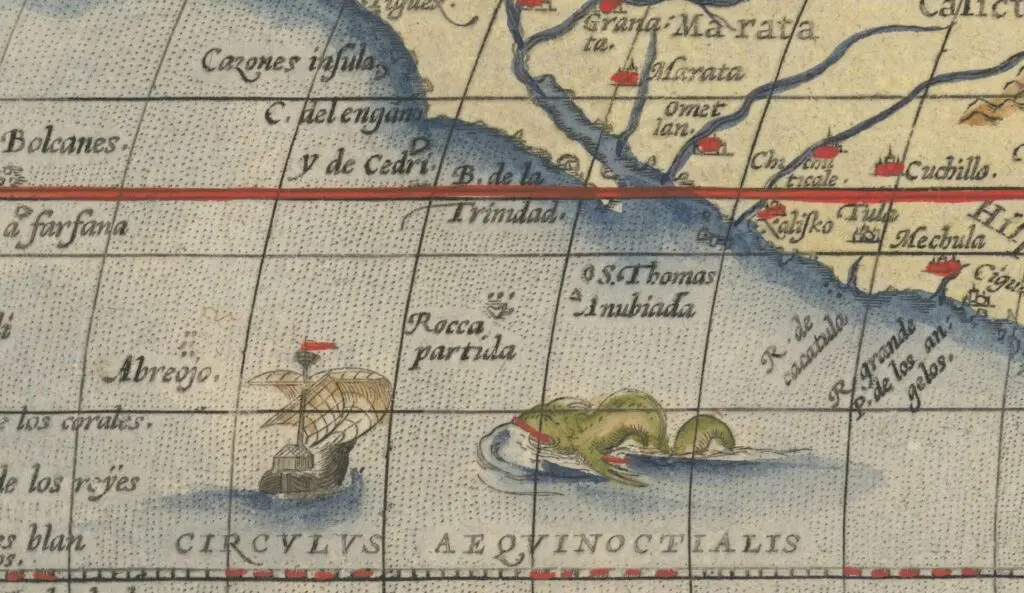
Dragons, sea serpents and blank spaces are hallmarks of medieval-European maps, representing geographic spaces that early cartographers knew were not yet known. In our modern age, it is commonly thought that there is no terra incognita left anymore on Earth — the world has been “discovered” and scientifically mapped. Yet there are vast parts of the natural world that remain unknown to us, leading me to wonder where the dragons and sea serpents — metaphorical or literal — will be found…
known knowns, known unknowns, and unknown unknowns
When I was a little girl, my grandfather‘s cousin Lenora introduced me to a short poem that contrasted what we know, what we know we don’t know, and what we don’t know we don’t know. (It was an earlier, more lyrical version of the famous quote by former US secretary of defense Donald Rumsfeld.) I was thrilled with the play on words and impressed by the ideas behind it. Now only a hazy memory, the essence of the poem still comes to mind when I hear about scientific discoveries — including of 100 new marine species in the waters off of New Zealand and of a remarkable species of palm in Borneo that flowers and fruits underground (which, it should be noted, was already known to local Indigenous people.)
For me, the excitement of these discoveries is matched by the wonderous thought of all that is out there in the world (and beyond!) still hidden or mysterious to us. How much of our world operates under our radar? And how much will we lose to habitat destruction and climate change before we detect it?
Searching for sea serpents
Experts estimate that there are more than two million species in our oceans — though they know of less than 10 percent of them. (A similarly low proportion of underground fungi have been unearthed.) Oceans are critical for human life (not least as a source of our food) as well as for the health of our planet (including as a carbon sink), and yet there is so much about the oceans we don’t know and don’t know we don’t know. These question marks punctuate the current debate about deep-sea mining: what will we risk by dredging up a part of our world that is still so poorly understood? Does the promise of mining minerals critical to modern technology — including those required to reduce carbon emissions and limit climate change, like wind turbines and electric cars — outweigh the many known and unknown unknowns of tampering with the ecosystem of the deep sea?

In an effort to safeguard wild plants around the world threatened by habitat destruction and climate change, the Millennium Seed Bank holds the seeds of 40,000 plant species, which can be lent to researchers and conservationists hoping to create more resilient plants and restore degraded ecosystems. This is, however, a limited conservation effort. First, conserving seeds in an underground vault cannot protect those species in the ecosystem that rely on the plants. Second, the bank’s current deposits cover only about 11 percent of the more than 350,000 vascular plant species that we know of today.
It goes without saying that the seed collection omits plants still yet to be discovered, including from the 32 countries considered “plant diversity darkspots” — modern-day blank spaces in the floral map — where scientists think there is a particularly high number of plant species still to be identified and mapped. Among these darkspots, the highest number of unknown species in the plant world is predicted to be in Colombia — the location of two habitats available to protect immediately through TiME. Frighteningly, scientists estimate that 77 percent of unknown plant species are at risk of extinction, because they have small populations and/or grow in a small geographic area.
Charting the new map of the Anthropocene
Considering the interdependence of species in an ecosystem, the extinction of any one species — those living in the deep seas or on land, known or unknown — will have a ripple effect on other species. While the magnitude of each ripple is unknown, we humans are likely to feel an impact: we may lose species we rely on directly for food or income and/or suffer from a degradation in the services provided by the ecosystem, like cleaning our water or pollinating our food.
There are other unknowable consequences of species extinction for human life —medicines never found, technologies never developed. Human progress has relied on the natural world for resources and ideas. Quinine, from the bark of cinchona trees native to the Andean rainforest, was the first anti-malarial drug; sonar technology was developed after learning how bats use echolocation to navigate and find prey. More recently, engineers created a series of robots modeled after snakes and scorpions to inspect the damaged reactors at Japan’s Fukushima Daiichi nuclear power plant. And a biodegradable seed robot, designed to monitor environmental conditions in air and soil, was inspired by the structure of the South African geranium seed, which moves and shape-shifts in response to changes in humidity. What more can we learn from the natural world — from those species we know of and others we may discover in the future — that will help improve our lives and heal our planet?
It seems to me that we need a complete map of our planet’s biodiversity, without blank spaces, to navigate our way through the many pressing problems facing our world — the Anthropocene’s monsters? — and to avoid creating new ones in the future. For that, we need to preserve as many threatened habitats as possible, as quickly as possible, to protect both known and unknown species.
TiME offers us a place to start, by identifying land available to purchase today in biodiversity hotspots: those areas of our planet that have extremely high biodiversity and are threatened by human activity. Donate and vote today to protect one of these threatened habitats: Cabildo Pada Kera, Los Magnolios, and Mount Sagyaan.
Author: Liat Radcliffe-Ross