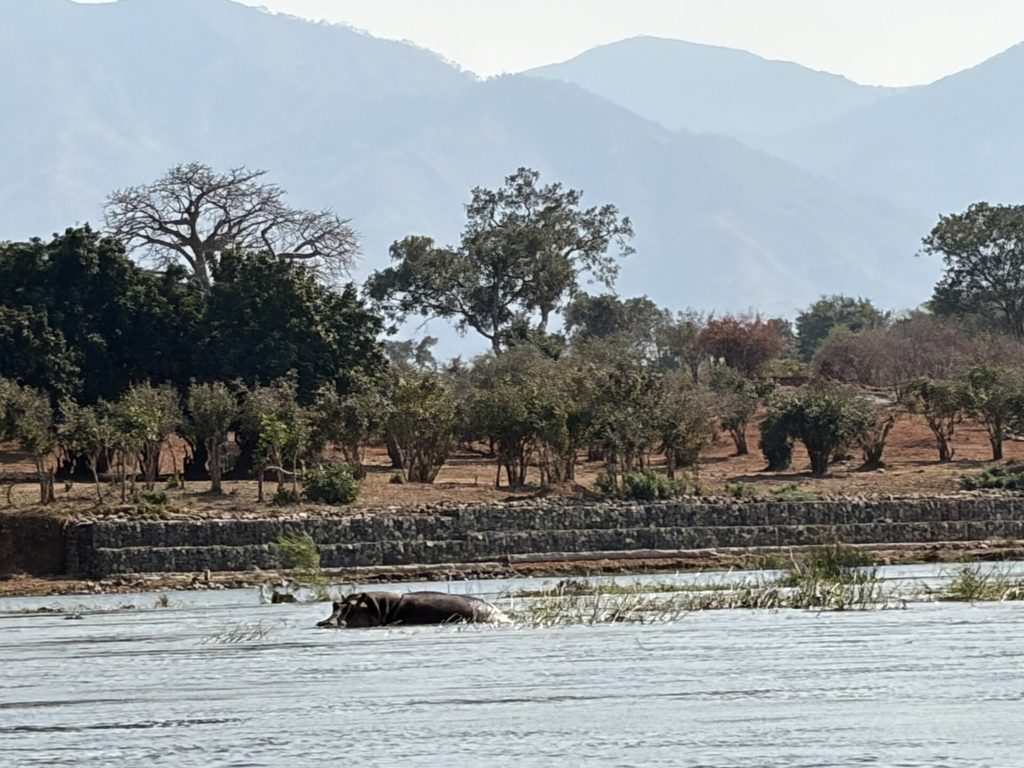
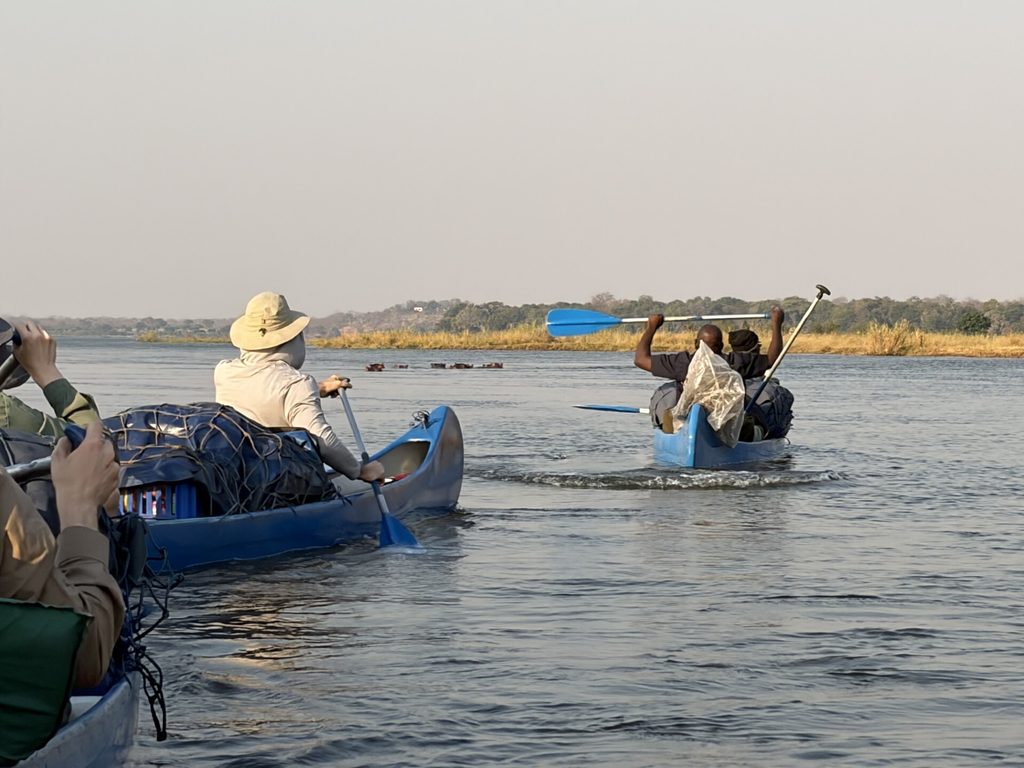
Canoeing down the Zambezi, Africa’s fourth-longest river, this summer, we had to quickly learn a few important things about Hippopotamuses: 1. they are very territorial; 2. they sleep during the day, often in the river; and 3. they can hold their breath underwater for up to five minutes! What this means practically for the canoeist is that you need to announce your approach by banging on the side of the canoe so that no hippo — especially those sleeping underwater and therefore invisible to you — will be surprised at your proximity and become (defensively) aggressive. Fortunately, we had an experienced guide, Martin, who taught us the rules and led the way on our three-day paddle down the river, at times insisting that we paddle quickly or make a sharp turn or wide semi-circle to avoid getting too close to the hippos claiming the waters as their own.
It felt a bit like a video game, in which the hippos were the guards of the Free Land of Wildlife and we humans were players trying to cross the land without upsetting the locals, which also included potentially dangerous African Savanna Elephants, African (or Cape) Buffalos, and Nile Crocodiles. We had to follow the animals’ rules and familiarize ourselves with their habits, giving them ample space and interpreting their social cues, including the stink eye a lone, one-horned African Buffalo shot us as we approached his corner of a small, grassy island. As if to level up in a video game, on our first evening we had to land our canoes on an islet in the river that was guarded by about eight hippos standing in the shallow water just beyond our landing site. Martin held his paddle above his head to appear as large and intimidating as possible to discourage the hippos from charging and allow us to reach our campsite.
A game for us; a way of life for the locals. Two fishermen who were paddling (standing up) in their dugout canoe past one of our campsites were grateful to hear from Martin the location of a nearby hippo so they could avoid it. All along the river’s edge, people have constructed short fences in semi-circles to allow them to draw water or wash without fear of a crocodile attack. And government officials must account for the unimpeded traffic across the river and thus between Zambia and Zimbabwe — this being the Free Land of Wildlife, our human-drawn borders are irrelevant — and compare notes when they do their wildlife surveys.
Changing the game
Some Zambians eat hippo — we were told it tastes like beef — but they have only rare opportunities to do so these days. Hippos and other wildlife are protected by law in Zambia, and Martin said that poaching has fallen dramatically since 2015 when the country introduced mandatory jail sentences for those caught killing wildlife — an elephant will get you five to ten years. Occasionally, government-employed rangers will kill an aggressive animal and distribute the meat to the local community, or an animal will be discovered dead (perhaps because of old age, an illness or a fight with another) and the meat divvied up by those who found it. That latter scenario seemed to be what we witnessed on our return to the river lodge by motor boat on the final day of our canoe trip: a brightly colored group of people stood huddled on one of the small, reedy river islands with a larger and no-less-colorful crowd standing on the river bank watching and waiting for their share of the prize.
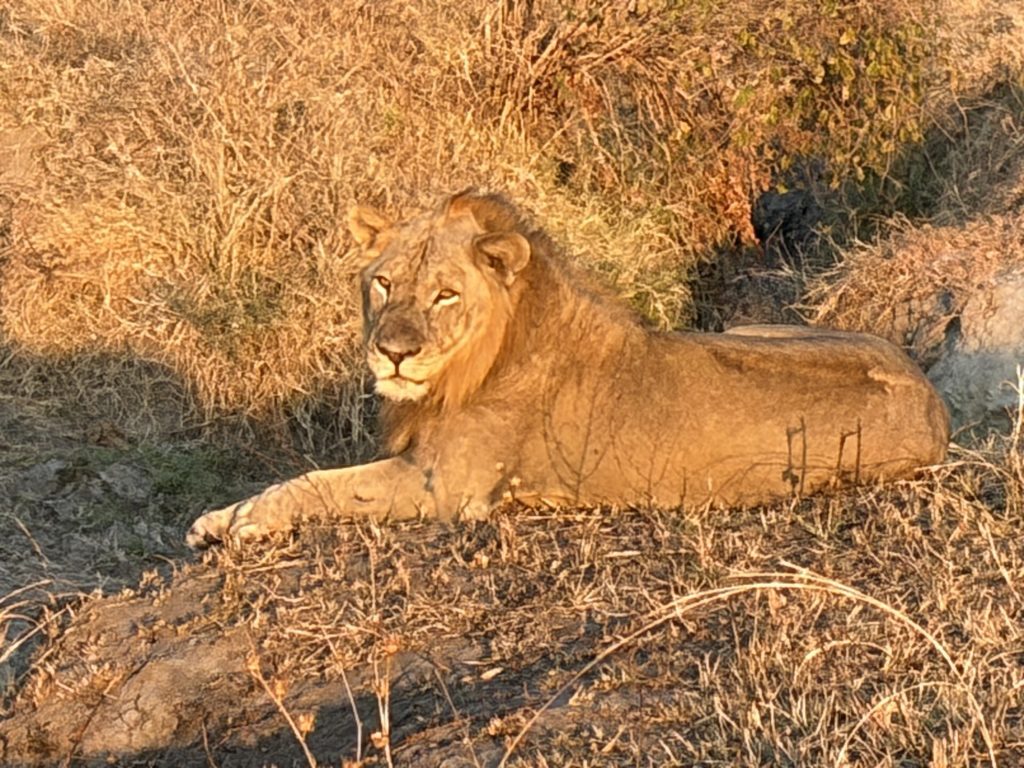
There are still areas in Zambia where hunting is allowed, but expensive licences are required, which are really only affordable to foreign tourists. In the mid-2010s, there were bans on trophy hunting and hunting big cats, but these were reversed within a few years. We were told that chiefs, who control communal lands in Zambia, were upset about the loss of revenue for their communities and lobbied the government to reinstate hunting. Apparently it is big business: a licence to hunt purchased from the government for US$5,000 can be resold to foreigners for US$150,000! While game management areas, as the hunting areas are known, offer much-needed income and employment to remote, often-impoverished communities, the temptation of financial windfall can also corrupt. Protected animals are sometimes lured outside of national parks into neighboring game management areas; Bryan, one of our safari guides, told us of two male lions from South Luangwa National Park that were drawn into this trap. We were also told of hunting lodges that compete for the local chief’s favour with gifts, including cars.
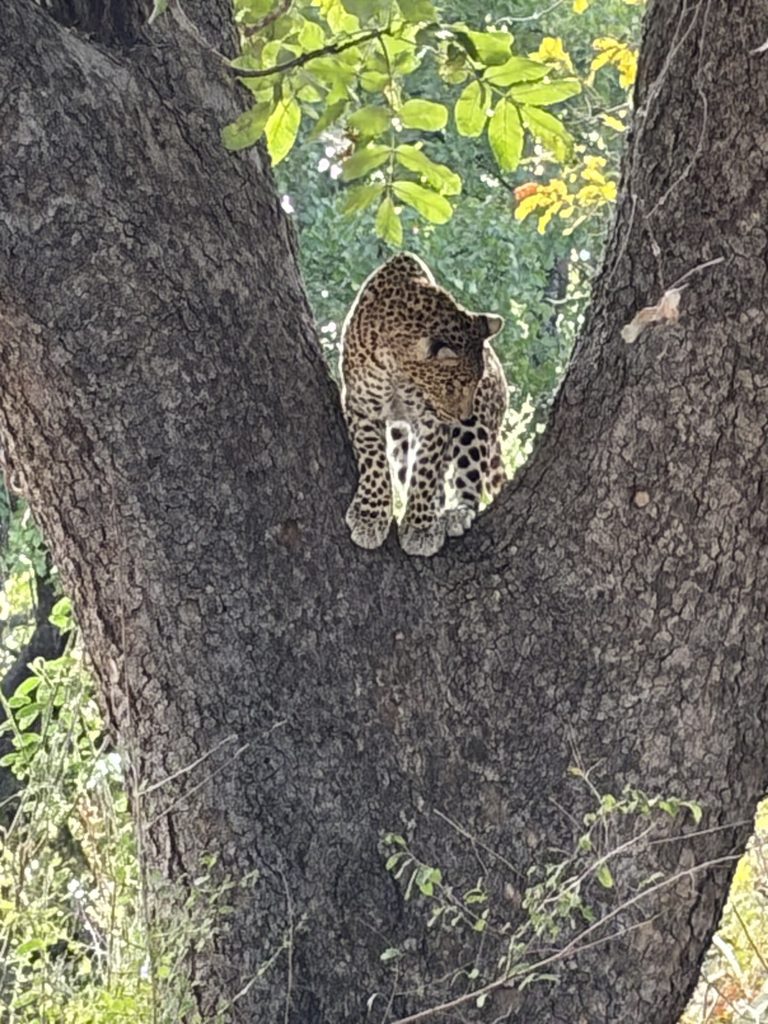
Chiefs have also been advocates for wildlife conservation. About ten years ago, a Lozi chief in western Zambia invited the conservation organization Panthera to co-develop a synthetic version of the traditional furs worn in an annual ceremony marking the flooding of the Zambezi and the king and queen’s seasonal relocation to their second palace. The king subsequently decreed that only synthetic furs should be worn ceremonially in order to safeguard wildlife. Many Lozi have since adopted the synthetic leopard skins, resulting in a dramatic decline in Leopard poaching and trafficking and an increase in the big cat’s density in the area.
Likewise, to reduce the demand for ivory and protect elephants, the traditional ivory bracelets worn by the Lozi are being replaced by ones made of cow bone or plastic. Authentic-ivory maseka that have been handed down from one generation to the next are now required to have a government-issued certificate, guaranteeing that the ivory was not taken from a recently poached elephant and hopefully extinguishing the market for new ivory.
Herculean efforts for conservation
Wildlife-protection efforts like these are taking place in the wake of an important case of national extinction. Zambia’s Critically Endangered Black Rhinoceros population was completely wiped out by the early 1990s due to poaching. In 2003, in an international effort to reintroduce them, a Hercules plane transported five rhinos from South Africa to North Luangwa National Park. Other airlifts brought more, babies were born, and the population now stands between fifty and one hundred.
On the surface, a conservation success, but scratch beneath it and a more complicated picture emerges. Due to the ongoing threat of poaching (and, we were told, the terms of contracts with foreign funders), the rhinos are protected 24/7 by a team of rangers, and an electrified fence keeps them enclosed in a protected part of the national park. The Rhinoceros Conservation Area, however, has become too small for this population of rhinos, and more than one have escaped the enclosure. In 2021, one male was found 220 km away in the South Luangwa National Park and had to be tranquilized and transported back to North Luangwa National Park, dangling mid-air in a sling beneath the helicopter, in order to ensure its protection. More than twenty years later, the project to reintroduce and rewild Black Rhinos in Zambia thus remains a work in progress. The rhinos cannot be completely rewilded; they remain hemmed in by humans in order to be protected from them.
Good fences make good neighbors
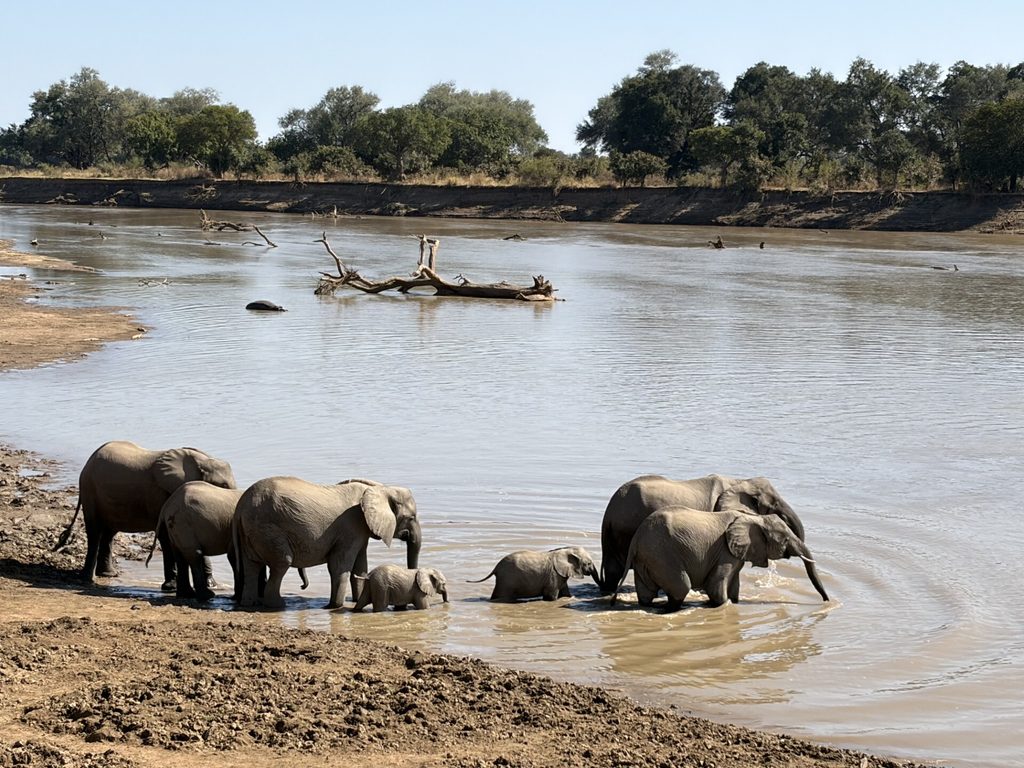
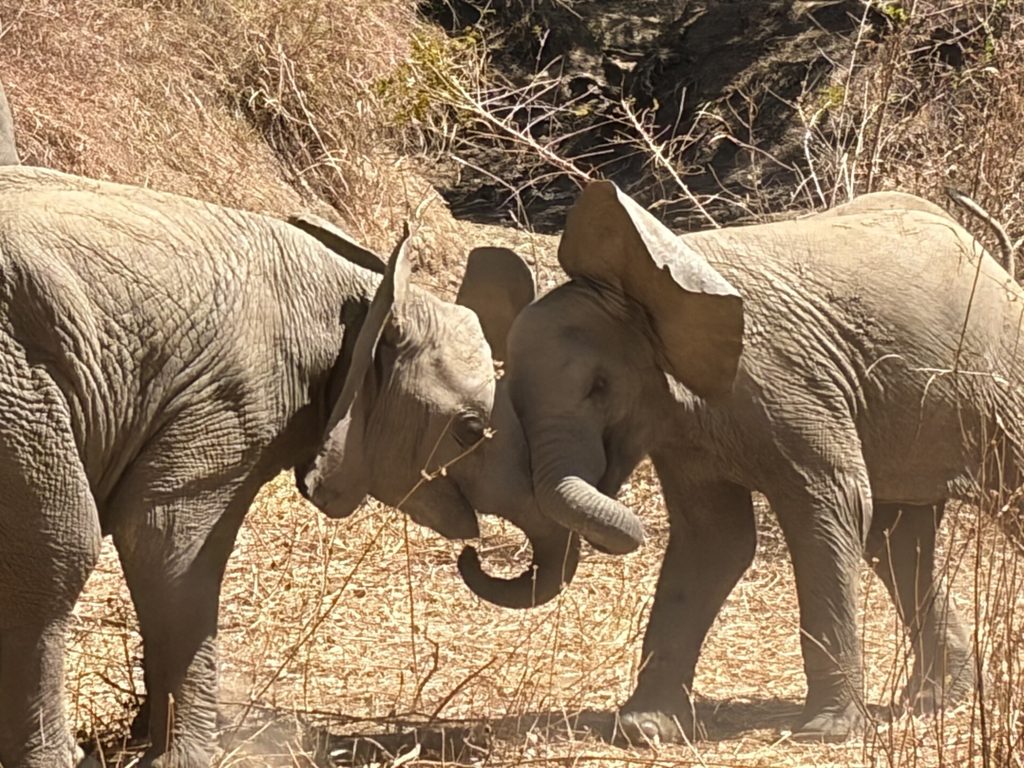
Elephants aren’t easily deterred. We stayed in three beautiful safari camps inside and beside the South Luangwa National Park in eastern Zambia and heard from several staff, many of whom live in the nearby village of Mkasanga, of their daily struggle to keep elephants out of their homes and gardens. “They don’t miss a night,” lamented Cooper, one of our guides. Elephants eat mangos from the villagers’ gardens and reach into homes — sometimes even damaging structures — to get into bags of maize. They even eat battery-operated devices! Walking in the national park, far from any road, we came across a battery amid a dried, spread-out heap of elephant dung. (African elephants, we learned, digest less than half [and potentially only 22 percent] of the food they consume, so other animals — like baboons — sift through their dung to eat the remnants. Fortunately these foragers were smart enough not to consume the battery, which also fortunately had not corroded and leaked battery acid before we found and collected it for proper disposal.)
Mkasanga residents have tried fences — the elephants knock them down. They have heard from other villages about the potential of bees to keep elephants away but worry about the bees stinging their children. Only electric fences have proven strong enough to keep local elephants out, but both these fences and the electricity to power them are not affordable to many people in Zambia. So the people of Mkasanga sleep with one ear open, listening for the elephants’ nightly foray into their village, at which point they jump out of bed and bang on pots, clap their hands and light fires to shoo them away. Some villagers have gotten dogs to help warn of the elephants’ approach.
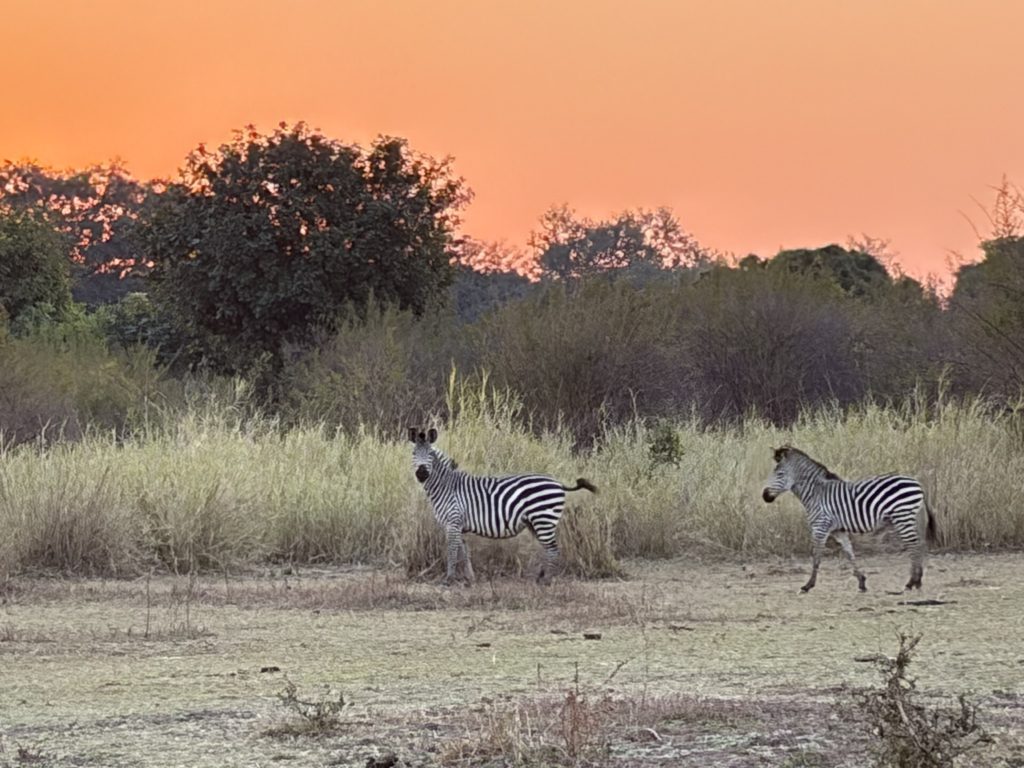
Locals are rightfully cautious around wild animals, but one strategy to prevent close encounters comes at a cost to the natural environment. All along the road from the town of Mfuwe through the national park and beyond, locals have set small fires on the sides of the road to remove trees, bushes and grasses to avoid being surprised by animals as they walk or cycle down the road. Blackened, burnt patches of earth are everywhere (as is litter from passers-by). However, if the fires are lit early enough in the dry season, green shoots can emerge to feed the local Crawshay’s Zebra, Puku and Impala when other food is scarce.
The conservation dance
To counter some of the negative feelings about wild animals held by locals, some of our safari guides take on the role of conservation advocate in their village. Cooper said he lets his neighbors watch his television — one of the few in the village — but tells them it is because of tourists coming to see the wildlife that he can pay for the TV and subscription that they enjoy, and therefore they should take care of the animals. And for decades, guides at Tafika camp have run the Chongololo (or millipede) Club for Mksanga’s school kids in an effort to cultivate curiosity about and goodwill toward wildlife. Demonstrating the club’s potential to inspire, at least two of our guides, Cooper and Mwila, were taught by Stephen, one of Tafika camp’s first safari guides. Children from the age of six are also invited to join guides on game drives in the park to view wildlife in their natural habitat (like TiME does with its educational program).
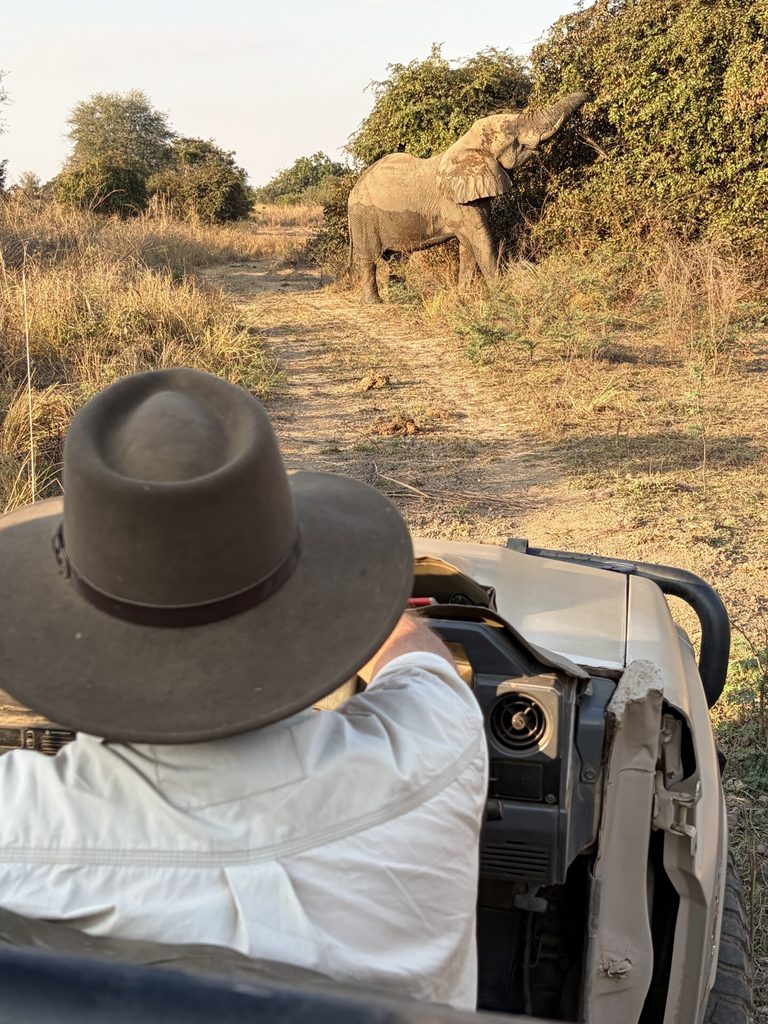
Nevertheless tourism is not a panacea. The income brought into local communities from ecotourism (and legal hunting) helps alleviate poverty and compensate for the real dangers and difficulties of living among wild animals. But tourist revenue is unevenly distributed and poverty remains a key driver of poaching. Tourism — even ecotourism — can also have negative environmental impacts. For instance, our campsites on the Zambezi were simply sandy grounds on tiny, grassy islands — you don’t want to pitch your tent on grasses favored by hungry hippos and elephants! There were no formal camping facilities and so inevitably waste was left behind: orange peels and onion skins in the river, water bottles along the shore, toilet paper on land.
The animals and natural landscapes we tourists come to see can also be impacted by our presence. I was amazed at the nonchalance that many animals in the Nsefu sector of the South Luangwa park showed toward our safari jeep. Though leopards are typically shy, one named Matima — which has been followed by a BBC camera crew since birth — walked right past our jeep and allowed us to follow her as she marked her scent along the dirt path. Hopefully this lack of fear of vehicles doesn’t endanger her in the future. Equally I hope the video footage capturing her majesty will impress and inspire viewers to support conservation in Zambia and around the world.
I came away from our trip to Zambia not only with great memories and photos, but also a better understanding of the dance that is conservation and the long-term commitment required to master the steps. Successful conservation must meet the economic needs, honor the cultural traditions, and consider the daily realities of local people living amid the wildlife we wish to protect. Foreigners can advance conservation if they listen carefully to local people and respond appropriately to their concerns. TiME’s model of partnering with local and Indigenous communities and organizations — which own and protect the land through a grant from TiME — seems to me an excellent way to promote long-lasting conservation, grounded in local knowledge.
We’d love to hear your stories! Let us know about conservation successes or challenges you’ve encountered in your local area or in places you’ve visited, and we’ll share them with the TiME community.
Author, adventurer and photographer: Liat Radcliffe Ross