Among the many themes that can be discussed in the biblical story of Adam and Eve is the divorce between humans and nature: After being immersed in nature, humans were banished from the garden and began to experience nature as strange and foreign. Seen from this angle, the big question conservationists must ask is: how do we preserve the garden and re-foster our connection with it, without returning to pre-modern times?
Iracambi’s story can be understood as one attempt to answer this question. The Brazilian nonprofit started as a midlife crisis: Binka Le Breton and her husband, Robin, lived in Washington, DC, where Robin was working for the World Bank and Binka was a concert pianist, when they decided to put their values to the test. Instead of just talking about environmental sustainability, they wanted to try it out. And so, a six-hour drive away from Rio de Janeiro, in a rural village in the Brazilian Atlantic Forest, they built Iracambi: a sustainable farm turned conservation, education and community-minded nonprofit.
I had the privilege to speak with Binka, together with Luisa Mendonça (Fundraising and Partnerships) and Thais Matos (a member of Iracambi’s financial team and a local resident), who told me about life in the Atlantic Forest and Iracambi’s mission.
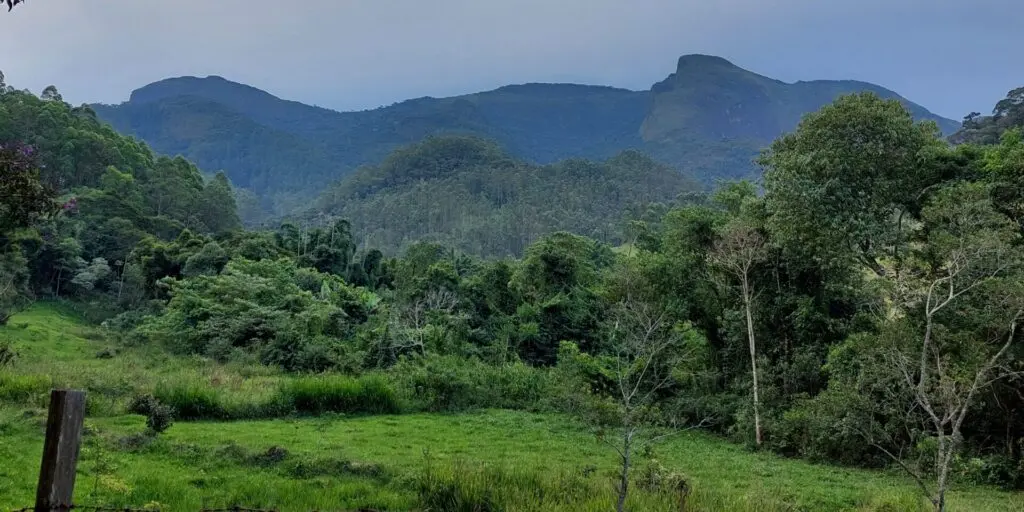
The goals of Iracambi require a delicate balance between conflicting perspectives on how humans and nature can coexist, which has created a complicated relationship between Iracambi, the local community and the forest. For Iracambi — and for conservationists more generally — the Atlantic Forest is an incredibly biodiverse hotspot that should be protected. Because it stretches along the Brazilian coast (and extends into parts of Paraguay and Argentina), covering different latitudes and altitudes, it is home to various habitats and many endemic species.
For the locals (mainly farmers), however, the forest takes up space that could be used to grow coffee. It is also a source of fear — teeming with wildlife and natural dangers — a force to be tamed, and a hindrance to making a livelihood. Humans have never truly lived in or with the forest without shaping or engaging with it; the idea of a pristine, untouched forest is largely unfounded. Yet, though the distance between the farmer and the trees increased as industrialization reached every corner of the Earth, the fear of the forest remained. More recently, as competition with corporations — as well as the cost of living — has risen, the need to make a profit has become more pressing. Consequently, most villagers near Iracambi do not feel the urgent need for conservation. The snake in this garden is both the temptation of profit and literal dangerous wildlife.
To work it and take care of it (Genesis 2:15)
But the paradigm is shifting, as can be demonstrated by another story about Adam and his garden. Bordering Iracambi is the farm of Adão (the Portuguese variant of Adam), who lives off the land and depends on a water spring located on the property, and who has cut down trees to cultivate coffee. As Iracambi’s neighbor, Adão was well aware of their advocacy for planting and preserving trees, but found it unconvincing. One day, he discovered that the spring in his garden had dried up, and the little water left tasted like rust. The spring kept him, his wife and his eight children alive, and the best solution he could come up with was sending his wife to collect water from the river. People at Iracambi saw her at the river and reminded her that should the spring not be restored, she would have to carry water from the river for the rest of her life. And so, soon after, she claimed to be sick, sending Adão to collect the water himself. Seeing how difficult the task was, he approached Iracambi and asked if they truly believed that planting trees could reinstate his spring. They said yes: Planting trees on the hillside above the spring would create a barrier against erosion, allowing rainwater to infiltrate the soil and replenish the aquifer, and the trees roots would decrease sediment buildup.
Unlike the biblical Adam, Adão was not banished from the garden and continues to cultivate it, now with more water and a renewed understanding of the ecosystem’s needs. “There wasn’t enough water for one house; now we have enough for four houses,” says Adão in a short documentary. Farmers like Adão often experience poverty caused by unsustainable farming practices that have been passed on for generations — but a shift in the paradigm can be positively carried on by future generations.
It may seem odd that people who live near the forest can miss this connection between the trees and the quality of water. For those of us living in the city, the idea of living in the forest can seem incredibly romantic, but the reality is much harsher. Forests are scary places where dangers are natural forces with venom and sharp teeth, hidden beneath the canopy. Close up, it is harder to see widespread and intensifying deforestation and its impact. Instead, the focus is on the need to make money, and for that end, the trees seem to take up space: Why plant and preserve them, if the land can be used to grow sellable products?
Thanks to the example, information and help provided by Iracambi and its advocates (like Adão today), more and more locals see the need to prioritize sustainable, eco-friendly farming. Together, they work on finding ways to develop sustainable, scalable agriculture.
But not all local landowners are farmers with a connection to the land. The current owner of Rocha Bros, which is available for your vote, is a businessperson who currently keeps cattle on the property. Their combined, sustained weight causes damage to the soil, which will be more difficult to reverse the longer it accumulates. Purchasing the land for conservation would ensure a biodiversity corridor connecting the Serra do Brigadeiro State Park to nearby restored forests. The preservation of the river in Rocha Bros is also crucial for the villages that live downstream and depend on it.
Trees of life
Locals call it the “spider monkey forest.” Rocha Bros is home to the Critically Endangered Woolly Spider Monkey, a relative of both the Critically Endangered Yellow-tailed Woolly Monkey that you saved in Peroles, Peru, and the Critically Endangered Brown Spider Monkey, which you protected in Magdalena Valley, Colombia — but thankfully, it’s not a relative of an actual spider, although we should save even that which scares us. Woolly Spider Monkeys are nicknamed “hippie monkeys” for their preference for non-aggressive conflict resolution, and there are fewer than a thousand of them left — all in Brazil.
Preserving Rocha Bros would protect all the strange and wonderful inhabitants of the forest, including the Endangered Vinaceous-breasted Amazon, a green parrot with a wine-red patch on its chest, and the Vulnerable Snake-necked Turtle, a turtle with a rapidly extending neck that has been described as “One of those animals that looks like it was designed by someone who thought, `What if a turtle could do a jump-scare?’” And new species keep being discovered, including two tiny frogs: the Endangered Brachycephalus darkside (which, despite its name, is bright orange) and the Near Threatened Physalaemus maximus (another misleading name: it is only five centimeters long — far from maximus).
Trees of Knowledge
Like TiME, Iracambi believes in education as a tool for changing paradigms and fostering connections. Twenty-five years ago, education in the local village was Little House on the Prairie-esque, with small, improvised classrooms, often within local farmhouses. Now, following Iracambi’s efforts to get county recognition, there is an actual, formal school.
Iracambi also runs the Young Eco Leaders program, which immerses children in the forest, working to cultivate a sense of responsibility toward it, together with critical thinking and leadership skills. The program focuses on encouraging children to speak up and represent their community and the forest, providing hands-on, practical experience in the tree nursery and other environmental actions. Graduates now dream of becoming foresters and biologists, studying, and supporting their birthplace. In what Binka and Luisa call the “trickle-up economy,” they bring those ideas home to their parents.
Thais (“our financial wizard,” Binka calls her) is a graduate of the program’s first cohort. “Iracambi was the place we used to go to as kids,” she tells me. “In any festivity or carnival, we used to come here and participate with Iracambi in their work.” By providing a safe, supportive and educational hub for local children, Iracambi was able to truly become part of the community.
Knowing good and evil
Loving nature and living right at the heart of it — “forest bathing,” as Luisa and Binka call it — can be very healing. Yet, seeing both its beauty and the rapid degradation of the land can be heartbreaking. Like Binka, Luisa is also originally a city-woman, coming from the nearby town of Tiradentes, and having also lived in São Paulo and Reykjavik. Luisa started working for Iracambi after discovering that, despite her love for the city and her degree in art, she needed to do something closer to the ground: Instead of just painting trees, she said, she wanted to plant them. Now she does both. Life at Iracambi is not always easy. The car can get stuck in the mud, and the power often goes out. Despite the difficulties — and the occasional retreat to Rio de Janeiro for a glass of wine — she has found a sense of community at Iracambi like no other.
Moving to the forest for the first time, Binka said, was much like returning to the 19th century. But her goal is not to immerse herself in traditional ways, nor to modernize the village. Instead, it is to find a path for the sustainable restoration of the forest in the 21st century. Few think we can truly return to Eden. Humanity has changed, our eyes have opened, and we have gained wisdom. Yet surely we can use this wisdom to conserve and restore the garden through a positive and reciprocal relationship with it.
One lesson we can draw on comes from an Indigenous tale found throughout the Americas, from Alaska to Tierra del Fuego, symbolized in Iracambi’s hummingbird logo. The story tells of a fire that broke out in the forest, sending all the animals to run for safety. Only the hummingbird could be seen flying back to the forest with a drop of water in its beak. “You will never put the fire out by yourself,” the eagle told her reproachfully.
“You’re right,” said the hummingbird, “but I am doing my part.”
We thank Binka Le Breton, Luisa Mendonça and Thais Matos for their help in preparing this article.